Jul 30, 2026
Why Digitizing Fuel Level Measurement Is a Game-Changer for Refined Fuel Users
Chart Industries is the world's leading cryogenic tank manufacturer. Where and why do your customers use level gauges on their tanks?
Our customers operate across medical, industrial, food, and beverage applications. Level measurement sits at the heart of every tank we ship. Whether it is a hospital managing liquid oxygen for patient care, a food processor relying on liquid nitrogen
for freezing lines, or a restaurant using carbon dioxide for their beverages. Knowing accurately what is in a tank at any given moment is fundamental.
Before adopting a digital solution like the C-Stic, what were the concrete limitations of mechanical gauges that your customers were experiencing?
The classic float gauge or differential pressure system was always a compromise. In cryogenic environments, moving parts are exposed to extreme temperatures, down to -196°C for liquid nitrogen, and they wear, they stick, they drift. Accuracy degrades over time. And the reading only exists locally, at the tank. No one can act on data that doesn’t reflect reality.
What drove the choice of the Rotarex C-Stic among the available solutions on the market?
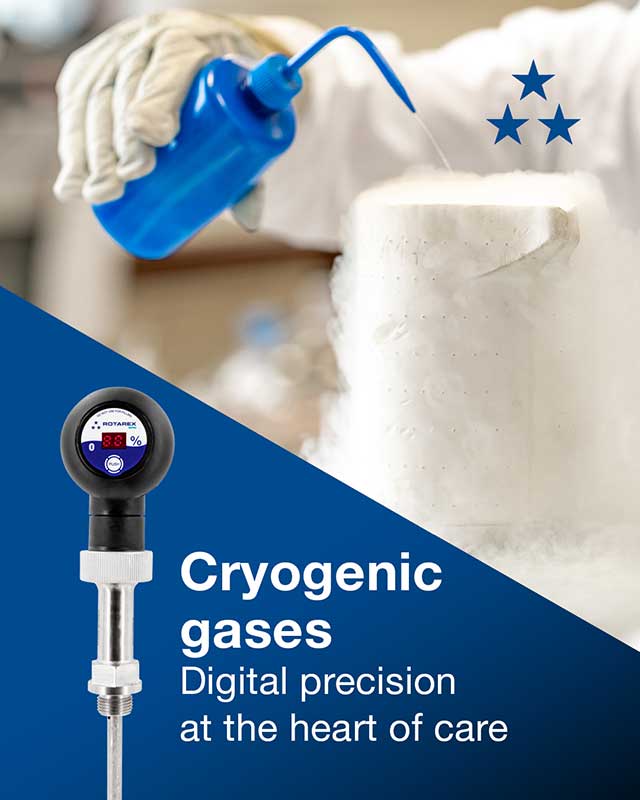
The capacitance measurement principle is particularly well-suited to cryogenic applications. There are no moving parts, so the sensor is genuinely maintenance-free in an environment where servicing a mechanical gauge can be complex and costly. The accuracy and repeatability within +/-1% over full scale is significantly better than what mechanical devices deliver in real operating conditions. And the product range covers our full tank portfolio, from liquid cylinders and MicroBulk to large stationary vessels.
The C-Stic is now available with Bluetooth connectivity and an integrated app. What does this concretely change for end-user customers?
It will be a fundamental shift in how people interact with their gas supply. A technician, a nurse, a lab manager: they can check the tank level directly from their phone, without needing to be physically in front of the equipment. For customers in medical or research environments, visibility directly reduces risk. For industrial users, it means proactive management based on facts.
And for distributors managing tank fleets, what does the cloud dashboard layer add?
Fleet visibility is the game-changer for gas distributors. The cloud-based dashboard means a logistics team can monitor dozens or hundreds of tanks in real time, prioritize deliveries based on actual consumption data, and eliminate wasted trips. That translates directly into cost savings and better customer service levels. The new connectivity option extends this even to remote locations where Bluetooth alone would not be sufficient, since existing monitoring solutions can wirelessly connect to the C-Stic at any time.
The C-Stic has evolved over the years. What do you consider the most significant leap between the previous generation and the current version?
The integration of wireless connectivity without compromising the robustness of the sensor is what stands out most. The previous generation was already a step up from mechanical gauges in terms of accuracy and reliability, but it remained a local instrument. The new C-Stic feature closes the loop. It has the same proven capacitance technology, now with Bluetooth access, a mobile app for end users, and a plug-and-play path to remote monitoring via third-party gateways.
The C-Stic range covers several variants - Lite, Industrial, Ex-Safe for LH2, Mobile for LNG. How does Chart approach this modularity when specifying equipment?
We appreciate that Rotarex has built a coherent family rather than isolated products. For standard liquid cylinders and microbulk, the C-Stic Lite covers the vast majority of applications. For harsher industrial installations, the Industrial version with its two analog outputs gives us the control and telemetry interface we need. And, as the hydrogen economy develops, both stationary LH2 and mobile LNG in Class 7 and 8 trucks having an Ex-Safe and a Mobile variant already available is genuinely important for us as a tank manufacturer.
Connectivity and data are at the core of the new generation of gauges. Where do you see the next evolutions in how industrial operators will manage their cryogenic gas inventories?
The direction is already abundantly clear: a predictive rather than a reactive approach. Today, connectivity tells you the current level. Tomorrow, the combination of consumption history, environmental data, and AI-assisted analytics will tell you when to order before you even need to. For critical applications like medical oxygen, that predictive capability is not a nice-to-have, it is a safety imperative. Solutions like the C-Stic, which already integrate cloud-based dashboards and fleet management tools, are laying the infrastructure for that next step.
What message would you send to cryogenic tank operators who are still hesitant to move from mechanical to digital?
The hesitation is understandable: people trust what they know. But the reliability case for capacitive digital gauges is now very strong. No moving parts means no wear, no maintenance cycles, no stuck floats in the middle of the night. The accuracy improvement over mechanical devices is measurable and significant. And the connectivity layer does not add complexity but it adds visibility. The C-Stic is a direct replacement for a mechanical gauge, meaning the transition is straightforward. The question is no longer whether to switch, but when.
To close, how does the partnership between Chart Industries and Rotarex reflect a shared vision for the gas industry?
Both companies share the conviction that the gas industry deserves instrumentation that matches the criticality of the applications it serves. Chart builds tanks and equipment to the highest engineering standards. Rotarex builds measurement and control solutions with the same philosophy. The Rotarex C-Stic performs exactly as promised, consistently, in some of the most demanding thermal environments in industry. That alignment of standards is what makes this partnership work.